Chicano 50 Cocktail Marks 50th Anniversary of the Founding of San Antonio CineFestival
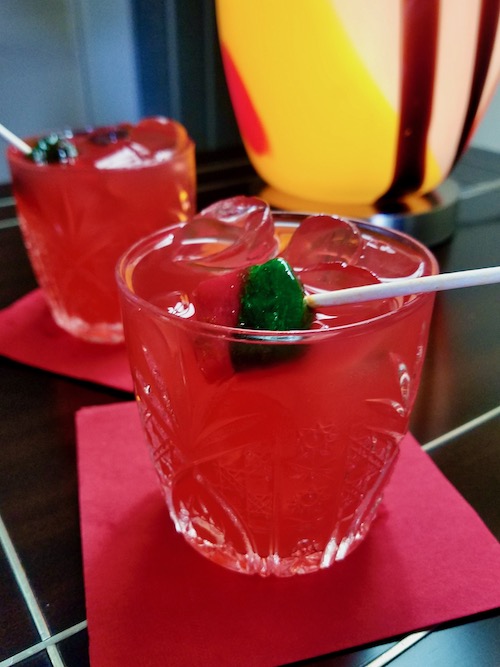
The Chicano 50 cocktail marks the Golden Anniversary of the year I founded the San Antonio CineFestival: 1976–2026. The 50th anniversary refers to the founding of the festival in 1976. Stewarded by San Antonio’s Guadalupe Cultural Arts Center since 1981, San Antonio CineFestival continues in its 47th edition, scheduled for July 9-12, 2026.
It is recognized as the first Latino film festival in the United States and now the nation’s longest-running Latino film festival.
See the press release below for the full details of the founding and history.
The Chicano 50 cocktail is a variation that I made on the Chicano 40 cocktail created by San Antonio mixologist Jeret Peña 10 years prior. Jeret creates a brilliant watermelon shrub, adds mezcal, Campari, tequila and finishes it with a chamoy watermelon popsicle!
Served as an agua fresca in a double old fashioned glass, the Chicano 50 cocktail retains the original’s bright watermelon notes and the popsicle!
Ingredients (makes two cocktails)
2 oz. Watermelon Shrub (recipe below)
1 oz Campari
1/2 oz Mezcal
2 1/2 oz Tequila
2 Chamoy-covered watermelon lollipops
To make the Watermelon Shrub (requires 24-48 hours prep time)
5 cups Watermelon
1/2 cup Sugar
3/4 cup Apple Cider vinegar
Method
1. In a blender, purée 5 cups of fresh watermelon and strain it through a fine mesh sieve. This will yield 3 cups of liquid.
2. Add the sugar and vinegar and stir until the sugar is completely dissolved.
Place in the refrigerator for 1-2 days.
To Mix the Cocktail
1. Mix all of the ingredients (except the lollipops) and stir until well blended.
2. Fill an 8–10 ounce Old fashioned glass with ice and pour the cocktail. Garnish with the lollipop.
Chicano 50 – Órale!
PRESS RELEASE:
A Projector in a Tree: 50 Years Since Adán Medrano Founded America’s First Latino Film Festival
Founded in 1976 as the Chicano Film Festival, the San Antonio CineFestival is now the nation’s longest-running Latino film festival.
SAN ANTONIO, Texas — This year marks the 50th anniversary of the founding of the San Antonio CineFestival by filmmaker and food writer Adán Medrano, a landmark in U.S. Latinx film history. Founded in 1976, it was originally named the Chicano Film Festival and is recognized as the first Latino film festival in the United States.
Stewarded by San Antonio’s Guadalupe Cultural Arts Center since 1981, the San Antonio CineFestival returns July 9–12, 2026, for its 47th edition, marking 50 years since its founding in 1976.
Its origins on August 25-26, 1976 were auspicious, if improvised. A 16-millimeter projector hoisted into a tree. White bed sheets stretched across the back wall of a building. An empty lot on the campus of San Antonio’s Oblate School of Theology. Flies and mosquitoes swarming the projectionist through two late-summer evenings.
That improvised beginning reflected a larger conviction behind the festival. At a time when institutional support for Latino media was scarce, Medrano believed that grassroots filmmakers across the country were creating localized stories that were not only national stories, but universal human stories. Their films shared themes of liberation, cultural celebration, historical investigation, and visions of the future emerging from the lived realities of the Chicano experience.
Medrano credits the Texas Commission on the Arts with taking an early chance on the concept through a $5,000 arts grant that made the first festival possible. The funds enabled him to identify, locate, and rent films from around the country — works he regarded as seminal expressions of emerging Chicano and Latino filmmaking.
But Medrano reserves his deepest gratitude for the small team of young friends who believed in the idea from the beginning and worked to bring it to life. He also credits the Mexican American community of San Antonio, whose response created the momentum that sustained the festival. That momentum began on the first evening of the inaugural screening, when approximately 2,500 people arrived to claim, witness, and celebrate stories that reflected their own lives and experiences.
Among the films selected by Medrano for the inaugural festival were Survival by Moctezuma Esparza; Requiem 29 by David Garcia; Dia de Plaza by Severo Perez and Judith Anne Perez; Los Vendidos by Luis Valdez and Luis Ruiz; La Madre: A Portrait by Adán Medrano and Carlos Amezcua; and The Case of Joe Campos Torres by Tony Bruni and Carlos Calbillo.
What began with a small team of young organizers quickly expanded into a citywide undertaking. Churches, television stations, newspapers, schools, professional organizations, businesses, and community associations across San Antonio joined the effort. The response surpassed expectations, attested by the 2,500 people who attended the two-night outdoor event, confirming a strong public hunger for these stories and for a cinema that reflected Chicano and Latino experience on its own terms.
Looking back today, Medrano points to one glaring absence in that first program: women-made films. The imbalance reflected broader realities within independent and Chicano filmmaking in the 1970s, where women’s work often struggled for visibility, funding, and distribution. Recognizing that gap, the festival later made women filmmakers, women’s leadership, and films made by women a central focus of one of its subsequent editions — an important expansion of the festival’s original vision and an effort to widen the field it had helped create.
For Medrano, the significance of that shift can be understood through works such as Sylvia Morales’ landmark film Chicana, a foundational intervention in Chicana feminist cinema, and the work of filmmakers such as Susan Racho, co-creator of The Bronze Screen, documenting Latino film history and representation in American cinema.
In 1980, the festival added the name San Antonio CineFestival to its official Chicano Film Festival title, thus anchoring its identity to the city where it has continued to cement its national reputation. The name transition was reflected in promotional artwork, including a poster by artist César Martínez that is part of the collection of the Smithsonian Institution.
In 1981, Medrano transferred the festival — together with foundation and National Endowment for the Arts funding attached to it — to the Guadalupe Cultural Arts Center. The move placed the festival within a strong cultural institution and community base.
“Looking back, transferring the festival to the Guadalupe Cultural Arts Center was one of the most consequential decisions of my career,” Medrano said. “It secured the festival’s future by embedding it within a robust organization and community.”
Five decades after a projector was lifted into a tree and films flickered across white sheets in a vacant lot, the festival’s founding vision — community-driven filmmaking rooted in the Chicano experience — continues to resonate.
Media Contact:
Adán Medrano
adan@jmcommunications.com
###