Two-Cheese Vegetable Chile Relleno
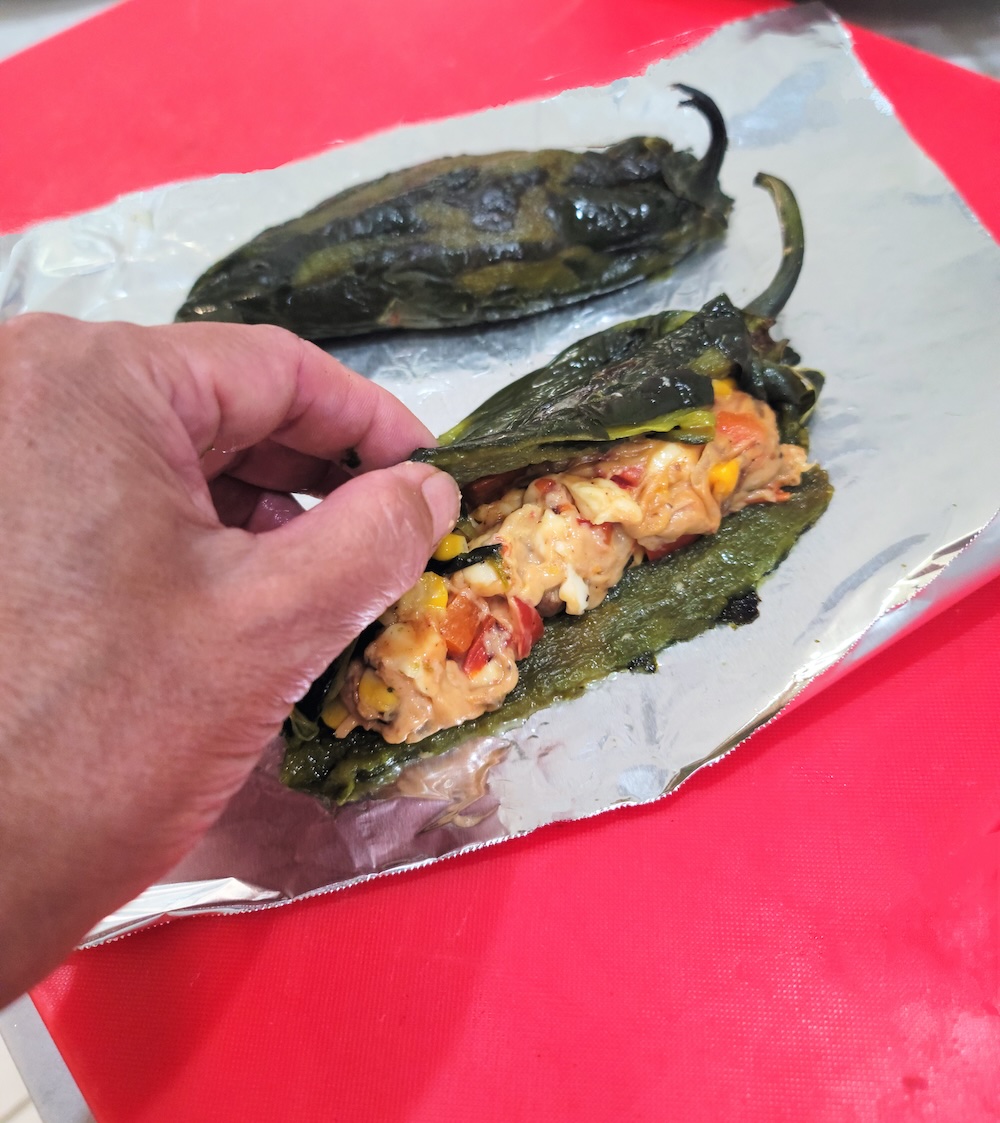
This recipe for two-cheese vegetable chile relleno features the flavor and texture contrast of two cheeses: creamy Oaxaca and sturdy panela. The vegetables adhere to the cheeses and the combination is complex, with a nice pop. This two-cheese vegetable chile relleno is a dish that you can make ahead for a dinner party or brunch. But first, I want to share an important topic, “agency,” that’s been on my mind:
Is the chile Poblano a creation of indigenous domestication or a hybrid creation of post-conquest cooks? The name of this chile is an example of how the conquest of the Americas continues to hide many indigenous memories and stories, thereby erasing indigenous agency. It’s time to embrace pre-conquest history and agency.
The name, “Poblano,” from the Mexican town of “Puebla,” assumes that this chile has Spanish origins because Puebla is a Spanish name and was founded by Spanish decree. I’d like for this recipe to be a reminder that the chile Poblano has roots that predate Puebla by millenia.
The origins of the chile poblano (Capsicum annuum L. var. annuum) lie in a deep history of chile cultivation in Mesoamerica that predates European contact by several millennia. Archaeobotanical and genetic studies confirm that C. annuum was domesticated independently in at least two regions of present-day Mexico. One widely recognized center is the Tehuacán Valley in Puebla, a region rich in early agricultural evidence. Another significant site is in the Texas Mexican region, Romero’s Cave, near Ocampo, Tamaulipas, where preserved seeds and paleobotanical remains suggest a second domestication locus for C. annuum, likely dating to between 6,500 and 5,000 BCE.¹ Together, these sites suggest a broad and ancient pattern of chile cultivation across central and northeastern Mexico.
While Capsicum annuum clearly existed in pre-Hispanic times, the term “poblano”—meaning “from Puebla”—only appears in the historical record during the colonial and postcolonial periods. Pre-contact documents, such as the Florentine Codex or Codex Mendoza, refer to chiles generically and do not distinguish specific varieties by name. Therefore, the absence of the word “poblano” in early texts cannot be taken as evidence that the pepper did not exist in some form prior to the conquest. Rather, it reflects the broader pattern in Mesoamerican sources of referencing ingredients by general category rather than by cultivar. The poblano, as it came to be known, was likely selected and stabilized through continued regional cultivation, with the name emerging in culinary records from Puebla in the 18th and 19th centuries, particularly in recipes such as chiles en nogada and mole poblano.
I hope this recipe helps to embrace the etirety of our history and identity.
Ingredients (makes 8 chiles rellenos)
8 Poblano chiles, green and firm
1 1/3 cups Oaxaca cheese, shredded or torn into small strips
2/3 cup Panela cheese, cut into 1/4″ cubes
4 tablespoons Crema Mexicana
1 cup onions, sliced into 1/8″ thick strips
1 cup red bell pepper 1/2″ dice
1 cup Roma tomatoes 1/2″ dice
1 1/2 cups cremini or white mushrooms sliced 1/4″ thick)
1 cup corn kernels, fresh, frozen or canned, drained
2 Tbs extra virgin olive oil
8 servings of Mexican rice, recipe here
Method
1. Place the chiles under a broiler. After about 5-7 minutes, when the chiles are roasted and a bit charred, turn them to roast the other side, also about 5 minutes, but watch them closely so they do not burn and turn black. The chiles will look slightly browned and blistered. Remove from the broiler and cover with a moist towel, allowing the chiles to rest for 15-20 minutes so that they will be easier to peel.
2. Place each chile flat on a cutting board and peel off the skin with your fingers. You can use a dull knife if you need to gently scrape off some of the skin, but this should not be necessary if the chiles are properly charred.
3. Keeping the chile flat, cut a slit lengthwise in each chile, and gently remove all the seeds from the stem and all the inside. Leave the stem intact and attached. Set aside the cleaned chiles.
4. In a 12″ skillet, heat 2 Tbs olive oil over medium heat and sautée the onions until they are soft and translucent, about 5 minutes. Add the mushrooms and cook for another 5 minutes, until the mushrooms are soft. Add the red bell pepper, corn kernels and the tomatoes and cook for another 5 minutes. Set aside.
5. Heat a deep skillet, preferably non-stick, over low to medium heat and add the Oaxaca cheese. Heat for about 3 minutes until it is almost fully melted, then add the panela cheese and the crema Mexican and mix well until the Oaxaca cheese is completely smooth but the panela is still holding its cubed shape.
6. Add the vegetables and gently combine thouroughly. I like to use a rubber spatula for this step.
7. Fill each chile with about 1 cup (more or less) of the vegetable and cheese mixture, just enough so that they close fully and feel compact. Close and lay the filled chile seam side down, side by side, in a rectangular casserole dish.
To serve, reheat in a 350ºF oven for about 20 minutes, until the cheese begins to bubble. On individual plasstes, place one chile atop a bed of Mexican rice and serve immediately with corn tortillas.
NOTE: After step 7, the chiles can be cooled and refrigerated for up to 3 days. Reheat as described above.
SOURCES;
¹ Kraft, K. H., M. H. Brown, G. P. Nabhan, E. A. Luedeling, M. de Jesús Luna Ruiz, S. D. Rooney, N. R. Dávila, and P. Gepts. “Multiple Lines of Evidence for the Origin of Domesticated Chili Pepper, Capsicum annuum, in Mexico.” Proceedings of the National Academy of Sciences 111, no. 17 (2014): 6165–70. https://doi.org/10.1073/pnas.1308933111.
Just discovered Texas Mexican. So enjoying the historical context of our rich culinary traditions! Thank you for sharing what you learn with us.